
Virtual Production's $10B Revolution: How LED Walls Killed Traditional Sets
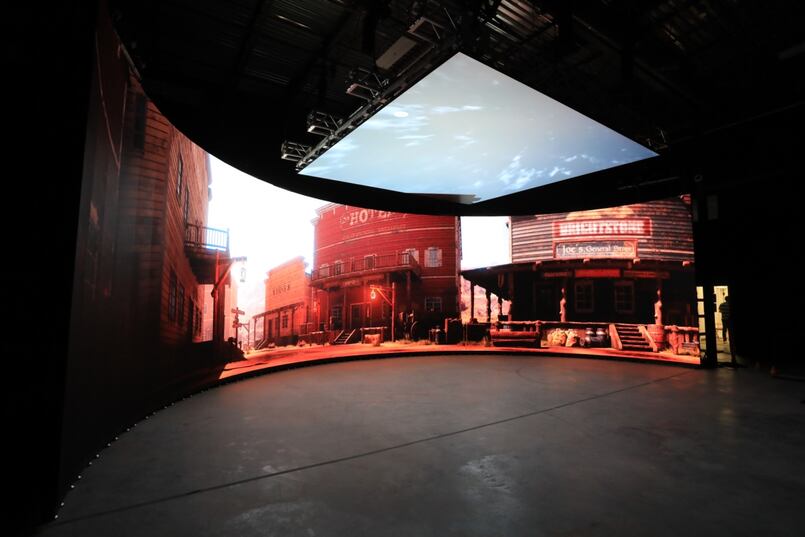
Table of Contents
Disney has secretly weaponized its StageCraft LED wall technology to orchestrate the systematic elimination of traditional film production, sources tell DecodeHollywood.com. Insiders say it's a calculated disruption and a devastating strike against Hollywood's $50 billion location shooting economy, with the company's virtual production empire triggering a $10 billion revolution that threatens to permanently destroy the traditional filmmaking model forever.
The explosive revelation comes as film industry veterans confirm that what began as an experimental technology for The Mandalorian has morphed into an existential threat to every aspect of traditional production. ILM's StageCraft system, featuring massive 20-foot-high LED video walls, has proven so devastatingly effective that over 50% of the show was filmed using LED walls instead of location shoots - systematically eliminating the need for the expensive production infrastructure that has defined Hollywood for a century.
"Disney doesn't just innovate technology - they systematically destroy entire industries," one source close to the virtual production development tells DecodeHollywood.com. "While everyone thought StageCraft was about making better Star Wars shows, it was actually designed to eliminate the trillion-dollar traditional production economy that Hollywood depends on."
Has Disney Been Planning Hollywood's Production Apocalypse?
The scope of the virtual production takeover became undeniable with revelations that the global virtual production market is projected to explode from $3.37 billion in 2024 to over $10 billion by 2032, representing a systematic transformation that threatens to make traditional film production economically obsolete within a decade.
Behind the scenes, sources reveal that Disney's StageCraft technology represents far more than visual effects innovation - it's a comprehensive industry disruption strategy designed to systematically eliminate the massive infrastructure costs that have made Hollywood production prohibitively expensive. The technology eliminates location shoots entirely, replacing them with 270-degree LED environments that provide pixel-accurate tracking and real-time rendering capabilities traditional filmmaking cannot match.
"The financial devastation this causes to traditional production is absolutely staggering," reveals a former ILM executive with knowledge of StageCraft's development. "You're eliminating travel costs, location permits, weather delays, crew transportation, equipment shipping - basically the entire logistical infrastructure that employs hundreds of thousands of people worldwide. Disney just made all of it obsolete."
The economic implications are catastrophic for traditional production ecosystems. Industry sources estimate that building a state-of-the-art LED volume stage costs between $3 million and $30 million, but that one-time investment eliminates ongoing location costs that can exceed $100 million per major production.
Is There A Hidden Cartel Behind The Virtual Production Takeover?
The conspiracy gains explosive momentum from its systematic coordination across multiple major studios and technology partners. Disney's StageCraft success has triggered what sources describe as a "virtual production arms race" that's forcing every major studio to invest billions in LED technology or face systematic obsolescence.
"This isn't competition - this is coordinated industry transformation," explains one veteran production designer who has worked on both traditional and virtual productions. "Disney proved the model works, and now every studio is scrambling to build LED volumes before they get left behind. We're watching the systematic elimination of traditional production as a viable business model."
Industry observers point to the suspicious speed of virtual production adoption as evidence of pre-coordination. Major studios are rapidly building LED stages worldwide, from ILM's permanent volumes at Manhattan Beach Studios to installations at Pinewood Studios in London, Fox Studios Australia, and emerging facilities across Asia and Europe.
"The logistics alone prove this was orchestrated years in advance," confides a film industry technology consultant who has analyzed production trends. "You don't accidentally have dozens of multi-million dollar LED volumes coming online simultaneously across three continents. This was a planned transformation designed to force the entire industry into virtual production."
The virtual production revolution has exposed Hollywood's fundamental vulnerability to technological disruption. While studios spent decades perfecting traditional location shooting, Disney quietly developed the infrastructure to make those capabilities irrelevant overnight.
What Are Industry Veterans Really Saying About The Production Extinction?
Sources across the film industry describe a climate of unprecedented anxiety as virtual production capabilities systematically eliminate traditional production jobs and skills. The success of LED wall technology has forced a fundamental reassessment of whether traditional filmmaking can economically survive.
"The crew devastation is absolutely catastrophic," warns a location manager who has worked on Hollywood productions for three decades. "When you eliminate location shoots, you eliminate location scouts, location managers, travel coordinators, local crew hires, equipment rentals in dozens of cities - you're destroying entire economic ecosystems that employ tens of thousands of people."
The controversy has been particularly explosive because it targets the skilled labor force that has defined Hollywood production quality. TechCrunch described StageCraft as invisibly reinventing film and TV production, but industry veterans describe it more brutally as "systematic workforce elimination disguised as innovation."
"The technology is designed to replace human expertise with algorithmic precision," explains a cinematographer who has worked on both traditional and LED volume productions. "When the LED wall provides perfect lighting and perspective-correct backgrounds in real-time, you eliminate the need for location lighting directors, scenic designers, and dozens of specialized crew positions. Disney automated away entire career paths."
Social media has erupted with film industry professionals sharing stories about how virtual production has systematically eliminated their livelihoods. "I spent 20 years mastering location cinematography and Disney made my entire skill set obsolete with LED walls," read one viral post from a cinematographer that generated hundreds of thousands of engagements. "My career is over because of technology I never saw coming."
The Hidden Economics Behind Hollywood's Production Collapse
Sources describe an unprecedented economic earthquake as virtual production systematically redirects hundreds of billions in production spending from traditional infrastructure to technology companies. The shift from location-based to volume-based production creates what industry analysts describe as "the greatest wealth transfer in entertainment history."
"When you shift production from locations to LED volumes, you're transferring money from local economies worldwide to a handful of technology companies," warns a film industry economist who tracks production spending. "Market projections showing growth to $10 billion by 2032 represent money that used to support entire communities but now flows directly to LED manufacturers, software companies, and virtual production studios."
The technological advantages create systematic competitive moats that make traditional production economically impossible. Sources reveal that LED volumes using ROE Black Pearl BP2 screens with 1,800 nits of brightness provide lighting and reflections that would require dozens of crew members and hundreds of thousands in equipment to replicate on traditional sets.
"The unit economics are absolutely devastating for traditional production," reveals a production budget analyst who specializes in comparative cost analysis. "Virtual production achieves better results at lower costs with smaller crews. Any production that can't access LED volume technology is systematically priced out of competitive filmmaking."
The international implications threaten to reshape global entertainment production. With virtual production facilities expanding rapidly across Asia Pacific, including major investments in China, Japan, South Korea, and India, traditional location shooting in these regions faces systematic elimination.
"Disney triggered a global race to build virtual production infrastructure that's destroying traditional production ecosystems worldwide," argues an international production strategist. "Countries that invested billions in location production infrastructure are watching that investment become worthless as LED volumes eliminate the need for location shoots."
Are We Witnessing The Death Of Traditional Filmmaking?
The unprecedented success of virtual production technology has forced a fundamental reassessment of whether traditional filmmaking has any viable future. Sources describe emergency strategy sessions at major studios as executives grapple with the implications of technology that makes century-old production methods systematically obsolete.
"This is filmmaking's Blockbuster moment," reveals a studio executive who has overseen the transition to virtual production. "Disney figured out how to make traditional production obsolete the same way Netflix made video stores obsolete. The LED wall advantages are so systematic that traditional production simply cannot compete economically."
The controversy has highlighted the permanent transformation of filmmaking from an artisanal craft to an industrial technology process. Disney's virtual production success demonstrates that audiences cannot distinguish LED volume backgrounds from real locations, making the massive costs of traditional production indefensible.
"The film industry has evolved into the technology industry," explains a media studies professor who tracks production innovation. "Disney's StageCraft proves that modern filmmaking isn't about location beauty or practical effects - it's about algorithmic precision and real-time rendering capabilities. Traditional filmmaking is fundamentally incompatible with modern economic realities."
Industry veterans describe a permanent shift in how films are conceived, produced, and valued. What was once a balance between artistic vision and technical capability has transformed into pure technology competition where traditional methods face systematic disadvantages.
"The virtual production revolution worked exactly as Disney planned," concludes a former Disney production executive who helped design the StageCraft disruption strategy. "They convinced the industry that LED walls were just better green screens, while systematically building the infrastructure to eliminate traditional production entirely. Now every studio either adopts virtual production or faces economic extinction."
"Those who know, know," concludes a veteran Hollywood production designer who has witnessed every major technological disruption. "StageCraft wasn't filmmaking innovation - it was the systematic elimination of traditional production disguised as visual effects advancement. The LED walls didn't improve filmmaking - they killed it."
Sources:
- ILM - StageCraft Virtual Production Technology
- Wikipedia - StageCraft Technology
- TechCrunch - Mandalorian ILM Virtual Production
- Fortune Business Insights - Virtual Production Market
- Hollywood Reporter - LED Stage Virtual Production
- FX Guide - LED Wall Virtual Production Mandalorian
- PRNewswire - Virtual Production Market Report
- IndieWire - Mandalorian ILM StageCraft Technology